|
Contest Elements: This contest tests identification
skills, compass skills, and ecological information. Youth will be
asked to identify from samples trees and plant leaves and fruits and
a few multiple choice questions about identification or natural
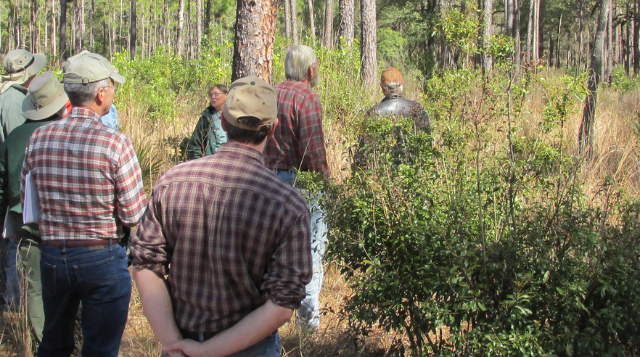
history features, insect and disease damage, and wildlife.Youth will also walk along a trail and identify
specimens in the woods. A multiple-choice portion of the
contest will cover two ecosystems: Tropical Hammock and Freshwater Swamp.
Youth will have a list of species from which they will copy the
appropriate number--they will not have to spell common names or know
Latin names. There will also be a section on map and compass
skills. There will be from 15 to 25 questions on each of six
sections; the Intermediate contest will be shorter than the Senior
contest.
In keeping with the ecosystems focus, the tree and plant species
for which Seniors are responsible for on the I.D. section of contest
will also emphasize species that are typical of Tropical Hammock and
Swamp ecosystems. The highlighted ecosystem descriptions contain
lists of trees and other plants that are not on the tree and plants
I.D. contest lists, but youth should know which ecosystem the plants
are associated with.
Contest
Participants: Youth will compete in teams of up to 4
individuals at both the Intermediate and Senior levels.
Intermediates are
youth between the ages of 11 and 13 years by September 1, of the
current 4H program year.
Seniors are between the ages of 14-18 as of September 1, the current
4H program year.
Each county can register up to 16 youth in 2 Intermediate and 2 Senior
teams. Individual youth may compete if there are not enough to
form a team. Teams of a minimum of 3 youth may be registered,
as the three highest scores from a 4-person team are used in
competition. Senior participants must not have been a previous
first place team winner.
In addition to team and individual winners in the Intermediate and
Senior contests, the team scoring the highest among first year
county contestants will also take home a trophy. Ties for
recognition will be broken by weighting sections of the contest in
this order: tree ID, plant ID, ecosystem quiz, insect/disease, field
map/compass. A $500 scholarship from the University of
Florida's School of Forest Resources and Conservation will be
offered to the Senior High Scoring Individual of the 4-H Forest
Ecology Contest if they choose to enroll at the University of
Florida and declare a major in the School of Forest Resources and
Conservation. The scholarship will be renewed for up to 3
additional years if a grade point average of 3.0 is maintained.
Contest Details: This year the Wildlife Habitat Evaluation Program
competition will NOT be held.
We will offer work stations where youth can ask questions about
forest plant identification and learn more about the contest. Counties are
encouraged to bring non-competing youth to learn more about both
contests. Please register these youth by printing and
completing the non-competing form. Youth who are competing in
one contest do NOT need to register to observe the other.
An Awards Ceremony will be held when all scoring is
concluded. We anticipate this will be between 1:30 and 3:00
p.m. Guided hikes and outdoor activities will be offered
between the conclusion of the competition and the awards
ceremony.
Training Information: This website provides all the
information 4-H'ers need in order to successfully compete in the 4-H
Forest Ecology Contest. Information is presented on forest
ecosystems, trees, plants, wildlife, forest healt, and map &
compass. Although it helps to go outside and identify real
trees and forest plants, you aren't limited to the plants growing in
your part of the state. This site includes over 120
descriptions of trees and plants with detailed photos--in all parts
of Florida.
The Contest will require 4-H'ers to be able to identify selected
forest trees and plants from Official Tree
and Plant
Lists. Each year, the lists will include:
- The eighteen dominant trees presented in the 4-H Forest
Resource Project Books;
- Selected trees from the Official List of the National 4-H
Forestry Invitational; and
- Trees and plants commonly found in a natural outdoor setting,
from branches or other significant parts, or from photographs
depicting key features of a tree or plant. There will also
be multiple-choice questions on how certain trees and plants can
be identified.
|