|
|
|
|
|

![]() |
|
| Glancy
Family Named as 1997 Stewardship Forest
Landowners of the Year |
| When we think of Florida’s forest lands, Dade County usually does not
come to mind. Once upon a time, however, Southeast Florida was covered
with thousands of acres of what has become known as the Pine Rocklands
Ecosystem. This community was typified by a scattered overstory of
South Florida Slash Pine, and an understory containing a variety of woody
and herbaceous plants. Frequent lightning-caused fires maintained this
ecosystem, and encouraged the growth of species adapted to the shallow
limestone soils and frequent fires.
Unfortunately, agriculture, urban development, the invasion of exotic species, and the lack of prescribed fire have eliminated all but a few small remnants of this community. Because of the effort involved in restoring and maintaining an area of pine rocklands ecosystem, only government land managers for the most part have undertaken the task. Terry and Barbara Glancy, however, have proceeded undaunted with the restoration of their 15-acre Pine Ridge Sanctuary over the past 23 years. Their efforts have earned them the title of 1997 Stewardship Forest Landowners of the Year. When the Glancys first purchased the property, only the pine trees were left from the original plant community. A thick jungle of exotic trees and shrubs obscured the native plants and made the area inhospitable for both wildlife and human access. Then the Glancys went to work. They used prescribed fire, spot treatments of herbicide, and their own hand labor to eradicate the unwanted vegetation. By the time we first visited their property in 1991, the restoration was almost complete. Dozens of native plant species had returned; The Nature Conservancy and Florida Native Plant Society were performing research there; and a number of other groups came to visit and marvel at what they saw. Unfortunately, Hurricane Andrew caused the Glancys a significant setback. It did not deter them, however. They resumed their prescribed fire and exotic plant eradication regime, and the results were evident when we visited again last year. They lost their most visible species, the pines, but gained several others in return. Some of these plants had not been seen in Dade County for decades. The snags left by the pines now provide habitat for birds and animals. Replanting the pines has involved making holes in the cap rock with a power drill. Talk about persistence! The regional Stewardship Forest Landowners of the Year include Joseph Parell of Washington County, J.C. Winn of Alachua County, and Wayne and Claudia Schumacher of Marion County. Each of these landowners has been actively involved with the management of their forest lands, and deserves recognition for their efforts. You, or someone you know, may be a good candidate for the 1998 Stewardship Forest Landowner of the Year award. Your management program does not have to be as unique or extensive as the Glancys, and may emphasize other resource amenities such as timber growth or wildlife habitat. We will be looking for worthy candidates for this award in a few months, so give it some thought. |
| Workshop
Report:
Integrating Wildlife Considerations for Your Timber Lands |
![]() |
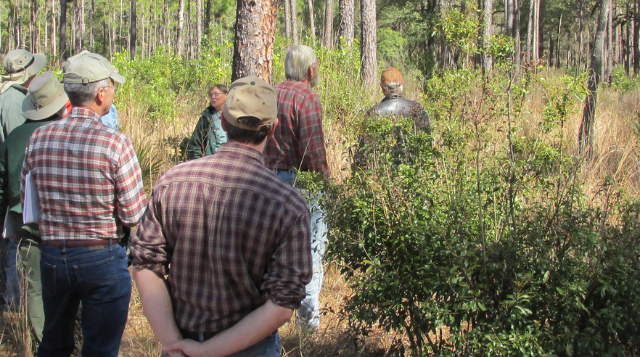
Last August, workshops on “Integrating Wildlife Considerations for Your Timber Lands” were held in Levy and Jefferson Counties. Jointly sponsored by the Florida Game and Fresh Water Fish Commission, the Cooperative Extension Service, and the Forest Stewardship Program, the workshops focused on forestry practices that promote successful -- and profitable -- management of both timber and wildlife. Each workshop included a visit to a landowner’s property and an evening session with several speakers. David Lewis of Southern Forestry Consultants spoke on harvesting options; Bob Simons, a landowner and consultant, spoke on forest regeneration; David Burt and Joe Shiver of Stone Container talked about alternative income opportunities and leases; Clay Olson briefly described shiitake mushroom cultivation; and Chuck McKelvy of the Game and Fresh Water Fish Commission concluded with a summary address on forestland management options. The following three articles are based on information presented at the workshops. |
| Integrating
Wildlife and Timber Considerations
(a summary of talks by David Lewis, Bob Simons and Chuck McKelvy) |
|
|
When managing forestland for both timber and wildlife, there are inherent
tradeoffs. You can’t maximize both resources on the same acre at the same
time. However, if you are willing to make some minor changes in your management
practices, you can provide substantial benefits to wildlife with little
impact on overall timber returns.
Forestry practices primarily affect wildlife through their effect on habitat. Simply stated, wildlife habitat is the arrangement of food, water, and cover that animals need to survive. Different wildlife species have different needs and, therefore, require different types of habitat. Habitat requirements for single species may also vary over the course of a year. Additionally, since different plants produce browse and fruit in different seasons, most wildlife species depend on a variety of food plants for survival. Knowing this, it is no surprise that habitat diversity or variety is the key to successful wildlife management. Inventory. Once you’ve decided to include wildlife in your management plan, the next step is to inventory your land. What types of plants, animals, and habitat are found on your land? Are there any areas of special importance to wildlife, such as den trees or pockets of hardwoods that provide large quantities of mast (fruits, nuts, seeds)? These are habitat components that cannot be readily replaced and should be conserved. A wildlife biologist can be very helpful during your inventory and subsequent planning. Timber harvest. Timber harvesting, including both selective cuts (e.g., thinnings) and
clearcuts, is one of the most influential forestry practices affecting
wildlife.
From a timber perspective, thinning removes inferior trees, reduces stocking, and gives trees room to grow in both diameter and value. From a wildlife perspective, thinning allows sunlight to reach the forest floor, and encourages the growth of grasses, forbs, and other browse. Increased habitat diversity results, providing food and cover for many wildlife species. Well-timed thinnings can maintain wildlife habitat through much of a stand’s life. In combination with other management actions such as prescribed fire, additional wildlife benefits can accrue. An important economic concern for landowners is whether the timber stand will provide enough volume in thinning to make a viable sale. About 40 to 45 loads of wood, or about one week of work for loggers, will generally be required. If your ownership is too small to support this amount of cutting, you might consider coordinating your sale with that of a neighbor. The larger combined harvest could increase the appeal for timber buyers, and therefore the value of your sale. Clearcuts severely alter existing habitat but provide the space and resources for the development of new types of habitat. Newly cleared sites are first colonized by grasses and herbaceous plants. Within a few years, a cover of shrubs and tree seedlings dominates the site. Eventually, this plant community is shaded out by the closed canopy of the crop trees. Each stage of development provides habitat for some species of wildlife, but excludes other species which have different habitat requirements. The removal of mature trees will displace animals that rely on a well-developed forest canopy, for example squirrels and some songbird species. But ground-level feeders, such as white-tailed deer, bobwhite quail, cottontail rabbits and wild turkeys, will benefit from the increased abundance of food plants that results from shade removal. It is important to always remember that many of these wildlife species also require the nearby presence of older stands and thickets for shelter and protection. Forestland that contains stands of different ages and stages of development will provide habitat for the greatest variety of wildlife. The quality and quantity of wildlife habitat is greatly affected by the size, shape, and spatial arrangement of clearcuts. Many wildlife species, including most game species, thrive at the “edges” between different habitat types, for example, in the transitional areas between different-aged timber stands or between forest and open field. Each habitat type contributes plants and animals to the edge area, making it more attractive to wildlife than either habitat type alone. If you create or maximize edge on your forest lands, many species of wildlife will benefit. Properly planned clearcuts can contribute to the edge effect. Proportionate to their area, small clearcuts provide more edge than large clearcuts. A good size for clearcuts might be a minimum of 20 acres and a maximum of 60 acres. If you have a stand larger than this, it is better to break it into several smaller clearcuts. Use natural boundaries, such as streams, swamps, ridges, or changes in soil types, as cutting boundaries if possible. Rectangular or irregularly shaped clearcuts provide more edge than square clearcuts. For example, a 40-acre square clearcut has 17,600 yards of edge, a 40-acre rectangular clearcut has 21,120 yards of edge, and two 20-acre square clearcuts have 24,640 yards of edge. A long, relatively narrow, irregular shape gives the most edge. The spatial arrangement of clearcuts is also important. If possible, avoid cutting adjacent stands in consecutive years. Allowing three to five years between adjacent clearcuts and “randomly” distributing these cuts over your timberland will greatly enhance habitat diversity. This cutting pattern will create a mosaic effect and prevent large expanses of similarly aged trees, increasing wildlife benefits across your property. Several simple practices, which can be included in your harvest plans, will further enhance habitat diversity. Retain streamside buffers, hardwood stringers beside intermittent streams, and hedgerows along fences. These provide food and cover for wildlife, and double as wildlife travel corridors. Also, during harvest and site preparation, protect the special wildlife habitats you identified during your inventory -- hardwood trees around sinkholes, den trees, snags, mast producing trees, and so on. For stand access, you might consider using fire lines and stand boundaries. If these are kept at least 15 feet wide, they can serve as permanent openings, providing food for a number of species and nesting sites for ground-nesting birds and mammals. All harvest operations require ramp areas where logs are collected and loaded on to trucks. If properly planned and located, these sites can be converted to permanent openings or wildlife food plots after harvest. Disking or root raking will help to break up the soil and improve production of legumes and other herbaceous plants. A wildlife biologist can help you identify special habitat areas, as
well as strategic locations for ramp areas and permanent openings.
Pine species. In Florida, harvested pine stands are generally replanted with slash pine, loblolly pine, longleaf pine, or sand pine. Species selection for a particular site is based mainly on soil characteristics, but also on the desired products. Pine species in plantations differ in their effect on wildlife habitat in two main ways: (1) the attractiveness of their seeds as a food source, and (2) the amount of shade they produce, and hence their effect on ground cover. With respect to wildlife habitat, longleaf pine is probably the most beneficial of the four pine species. It produces the least shade; therefore, ground cover is maintained longer into the stand rotation. Because of its tolerance to fire, longleaf also allows you to initiate the use of prescribed fire at an earlier age. This practice promotes the growth of nutritious wildlife browse. Also, longleaf’s large seeds are attractive to many wildlife species, such as turkeys, squirrels, quail, and doves. Next in order of preference would be slash pine. It produces more shade than longleaf, but less than loblolly pine and sand pine. Slash pine cones mature earlier than longleaf, and the seeds are attractive to wildlife, although not as attractive as longleaf seeds. Compared to the first two species, loblolly pine is less desirable for wildlife. It has relatively heavy shade and its small seeds are not nearly as attractive to wildlife. Sand pine is the least desirable of the four pine species, in terms of wildlife habitat, because it shades out virtually all of the ground cover. Of course, stand density has a noticeable effect on the amount of shade in a stand, regardless of tree species. Summary. For landowners who want to blend forest and wildlife management, the
most important steps are to:
Keep in mind that habitat diversity is the key to successful wildlife management. We tend to think of management from a stand perspective – the management of individual stands – but wildlife move freely between stands, taking what each has to offer. Realistically, from a wildlife perspective, trying to meet the habitat needs of a variety of species, we need to look at a larger scale, a landscape scale. We need to consider the arrangement and distribution of habitat types across the land. Although timber revenue is the primary concern of many landowners, the majority also have a sincere interest in wildlife and aesthetics. Varying our forest management across the landscape can help accommodate all of these interests. Five important guidelines come to mind:
|
|
|
Reforestation and timber stand management can be expensive propositions,
with the big pay day a long time down the road. Any opportunity to earn
income between cuts is likely to be welcome, especially by small timberland
owners. At the “Integrating Wildlife Considerations for Your Timberland”
workshop, David Burt and Joe Shiver discussed options for earning non-timber
revenue on private forestlands.
Opportunities to earn income from non-traditional forest uses have grown in recent years, especially with the increasing willingness of people to pay attractive sums for recreational activities and wildlife experiences. Hunting leases are probably the best known and most used source of periodic income, but other leasing opportunities are becoming more common. Some examples are fishing, horseback riding, bicycle and motorcycle riding, bird watching, nature trails, campgrounds, and even battle sites for paintball war-games. Non-recreational leases include activities such as pine straw harvest, cattle grazing, and firewood. Although all of these activities were mentioned during the wildlife workshop, please note that not all of them will benefit wildlife populations. For example, management for pine straw harvesting leaves little understory vegetation for wildlife use. Both David Burt and Joe Shiver repeatedly stressed the importance of having written contracts: written leases for anything that occurs on your timberland. This may seem paranoid, and contrary to the informal way you prefer to do things, but nevertheless--PROTECT YOURSELF. Anytime someone comes on your land, you are more or less responsible for their safety. In our lawsuit-crazy society, you risk losing everything if someone is injured while on your property. In addition, a lease ensures timely payment to the lessor, as well as defines the specific obligations that each party has to the other. Hire a lawyer to assist you in writing a detailed contract. This is money well-spent. A contract not only protects you, but also allows you to retain control over what is happening on your land. There will be no misunderstandings if everything is written down beforehand. Each type of leasing activity has different risks, rewards, and requirements,
so the information in a lease needs to be tailored to the specific activity
and to your preferences. Most, if not all, leases should contain the following
elements.
The names and addresses of everyone involved in the lease, and the address of the leased property. Be specific. Will you allow only deer hunting or hunting for all game species? Are there landowner rights you wish to protect? Give a legal description and a detailed map. You can also list areas that are excluded from the lease. Clearly state what is allowed and what is not allowed. Examples: no dog hunting, alcohol, fires, or nails in trees; the number of hunters at one time; responsibility for gates and fences. What you will or won’t do to improve conditions. Will you allow sub-leasing of hunting rights, pastures, pine straw collection, etc.? If rights are sub-leased, you may lose control of what is happening on your land. This element is extremely important. Witnessed and notarized signatures of the lessee and lessor. Income from alligator habitat. If you have gator habitat on your land, the Private Lands Alligator
Management Program, administered by the Florida Game and Fresh Water Fish
Commission, might provide some extra income. This program was created to
provide landowners with an incentive for protecting wetlands habitat. To
qualify, landowners or groups of landowners must have 1000 acres of habitat
or 100 gators longer than four feet. After the habitat has been surveyed
by a professional wildlife biologist, and a permit granted, landowners
can harvest a certain number of alligators, eggs, or hatchlings. Generally,
the landowner contracts with a trapper, and the two parties split the profits
in a pre-determined fashion. As with other forestland activities, make
sure you have a good written contract to protect your interests.
|
| Shiitake Mushrooms, Part 2 |
| The last issue of The Florida Forest Steward contained an article
which described shiitake mushroom cultivation in Florida. At the wildlife
workshops, Clay Olson, a co-author of the UF extension publication on shiitake
mushrooms, mentioned a couple of additional points that are worth passing
on. First, he warned that heavy rain can damage mushrooms so it
is important to keep them under some sort of shelter. Second, he
noted that mushroom production in Florida occurs in fall, winter and spring,
while the more northern states have two production peaks: March and fall.
Since Florida growers can continue to supply mushrooms after production
has ended in the north, they may have a marketing advantage.
|
| SFRC/Florida
Cooperative Extension Service Publications on Topics
Addressed in the Wildlife Workshops |
| Management of Pine Forests for Selected Wildlife in Florida.
W.R. Marion, M. Werner, and G.W. Tanner. Circular 706
Making the Most of Your Mast. C.M. Sekerak and G.W. Tanner. SS-FOR-3 Wildlife Habitat Considerations When Burning and Roller Chopping Florida Range. G.W. Tanner and W.R. Marion. WRS-6 Hunting Lease Arrangements in Florida and the Southeast. W.R. Marion and C.A. Gates. Circular 793 Alternative Enterprises for Your Forest Land: Forest Grazing, Christmas Trees, Hunting Leases, Pine Straw, Fee Fishing and Firewood. M.L. Duryea (ed.). Circular 810 To obtain copies, contact your county Cooperative Extension Office. |
| Timber Price Update |
| The 4th quarter, Timber-Mart South report for Florida, listed average stumpage prices in the last three months of 1997 as $41/cord for pine pulpwood, $79/cord for pine C-N-S and $116/cord for pine plylogs. Prices were $2, $9 and $9 per cord, respectively, higher than in the third quarter. Hardwood pulpwood prices rose 20% between quarters, but hardwood timber prices dropped slightly. As previous newsletters have pointed out, stumpage prices are highly variable and the actual price for a particular timber sale can be affected by characteristics such as tract size, timber density, access, proximity to mills, and weather. Although the first quarter, 1998, summary is not yet out, it will show a distinct weather effect, with prices considerably higher than at the end of 1997. Some of you have experienced that benefit of the weather in your timber sales in the last four months! A more complete summary of fourth quarter stumpage prices is available at your County Extension Office. To determine current prices in your area, your best source of information will be forestry consultants and timber companies that conduct timber sales or buy timber. |
| WHIP Acreage Correction |
|
|
In the last issue, we reported that to qualify for WHIP cost-shares, “...proposed treatment areas must be at least 20 acres in size.” This statement is incorrect. The correct statement is as follows: “To qualify, total ownership must be at least 20 acres in size. Proposed treatment areas, however, can be much smaller.” |
| Stewardship Workshops |
![]() |
Regeneration Options for Non-industrial Forest Landowners will
be held June 23 in Milton.
Pine Straw Management will be held in October, probably in the Panhandle and northeast Florida. You will receive announcements for these workshops in the mail. |
|
|
Natural Resources Forum ‘98: Linkages in Ecosystem
Science, Management and Restoration.
University of Florida, Conference Dept., Suite E, 2209 NW 13th St., Gainesville, FL 32609 Phone: (352) 392-1701, ext. 243 1998 Southern Landowner Outreach Conference
|
|
|
|
|
| A University of Florida Cooperative Extension Service and Florida
Division of Forestry joint project:
Chris Latt (editor), School of Forest Resources
& Conservation, UF, P.O. Box 110410, Gainesville, FL 32611-0410,
(352) 846-2375 or CRLA@gnv.ifas.ufl.edu
|