|
|
|
|
|

| A University of Florida Cooperative Extension
Service and Florida Division of Forestry joint project:
Chris Demers (editor), School of Forest Resources
& Conservation, UF, P.O. Box 110410, Gainesville, FL 32611-0410,
(352) 846-2375 or cdemers@gnv.ifas.ufl.edu
|

| Urbanization and Changing Forest Values |
| This year's John Grey Distinguished Lecturer at the SAF/SFRC Spring
Symposium was Dr. Ross Whaley, immediate past president of the State University
of New York College of Environmental Science and Forestry in Syracuse.
His intriguing talk outlined 5 major trends in globalization and addressed
how we as foresters fit into the big picture. The 5 trends included:
population growth, international trade, an unprecedented number of products
available to consumers, changes in energy demand, and changing attitudes
about forests. Since his talk I've attempted to fit his points into
a private-landowner context. Some thoughts on this are manifested
in this article. I will expand on the first and fifth trends that
Dr. Whaley discussed: population growth and changing attitudes about forests. Articles in the March 2000 Journal of Forestry and Vardaman's April 2000 Green Sheet (James M. Vardaman & Co., Inc.) were also used for some ideas and illustration. Let's start with today's economic trend. Americans taking advantage of today's booming economy are finding themselves with the ability to pursue their dreams of land ownership. As a result, large portions of the South and other rural areas of the country are now experiencing a "land-boom" - a significant rise in bare-land value. This is particularly evident in the urban-rural interface, where a growing number of wealthy urban residents are migrating out of the city in search of a sanctuary from the hustle and bustle of urban life. This migration has been termed exurbanization. Exurbanization is often motivated by a perceived improvement in the quality of life in rural areas. Land ownership in a rural area can bring spiritual, recreational, and productive opportunities that are uncommon in the urban environment. As urban centers grow and expand, more people are pursuing residence in outlying areas, and this migration is slowly bringing about change in the physical and social components of the rural landscape. Urban migrants often have attitudes, needs, and values that are quite different from traditional rural residents. Most traditional rural landowners see their land as a working asset that must be actively managed for continued production. Urban migrants are more likely to have preservation-oriented values and are therefore more likely to support land-use controls than traditional residents. These new landowners may be more accustomed to zoning restrictions and are likely to embrace such restrictions as ways to protect and increase home value. Another dimension to this trend is forest fragmentation. I recently saw an advertisement on television for 20-acre "plantations" in the Gainesville vicinity - a perfect example of forest fragmentation. The concept is simple mathematics. Since our land base doesn't expand with the population, more people will own fewer acres. An article in the Journal of Forestry entitled "Forest Fragmentation: Implications for Sustainable Private Forests", by Neil Sampson and Lester DeCoster, gave some interesting statistics regarding this trend. A 1994 study found that of the 9.9 million private landowners in the U.S., 94% owned less than 100 acres of forest apiece, and there are about 150,000 new forest landowners every year. If this trend continues, by 2010, about 150 million acres of productive forest in the U.S. will be in pieces of 100 acres or smaller, with an average holding size of 17 acres. This, coupled with the changing demographics discussed above will have vast implications for forest practice in rural America. Urban migrants will be less likely to participate in forestry programs because forestry will likely be only a minor concern in their ownership objectives. 20 acres is probably more than enough for an owner whose land management objectives amount to a landscaped yard and some trees. What can the traditional private forest landowner do to avoid this trend? The answer is simple (in words at least): forest stewardship. Your land is irreplaceable. Hold on to it and add value to it; value in terms of product output and "greenspace" or wildlife habitat. As urban areas encroach on the landscape, productive forests and other important values like wildlife habitat and aesthetics will likely be at a premium, which may translate into significant opportunities for landowners providing them. My bias aside, I would think that those of you in the Stewardship Program are already a step ahead in ensuring the future of your forestland. You have well-defined, long-term, multiple-use goals and a management plan to help you achieve those goals. However, stewardship alone will not perpetuate a forest property. Uncle Sam gets his share when you are gone, so an estate plan is needed to ensure the transfer of your property to your heirs with as little tax liability as possible. Otherwise, your heirs may be forced to have to sell the property just to pay the inheritance taxes. |
| National
Wild Turkey Federation Private Lands Program - Wild Turkey Woodlands
Bryan J. Burhans, NWTF Director of Land Management Programs |
| The National Wild Turkey Federation (NWTF) recently initiated a new
private lands program called Wild Turkey Woodlands. This free program
recognizes individual and corporate landowners that actively manage for
wild turkeys and other wildlife on their farms, ranches, and woodlands.
The program also promotes hunting as part of our North American heritage.
A Wild Turkey Woodland is a privately held farm, forest, ranch or woodlot managed to protect and enhance wildlife habitat. Landowners owning at least 10 acres are eligible, and certification is awarded once a property meets the standards set by the National Wild Turkey Federation's Wild Turkey Woodlands program. Certified landowners can send a strong message to their community about their active support for wildlife on their property with a Wild Turkey Woodlands sign. In addition, a Wild Turkey Woodlands certificate, suitable for framing, will show those visiting their home or office that their land is managed for wildlife. Another benefit of participation in this program is access to information
and resources. Wild Turkey Woodland owners will receive the latest
information on new products and wildlife management techniques, and can
take advantage of special discounts on seeds and seedlings. As the
program grows, a newsletter will be published and regional workshops will
be available to provide landowners hands-on information about management
options. An annual state, regional and national awards program is
held to showcase the efforts of selected certified landowners in managing
for turkeys and other wildlife.
|
| Northern
Bobwhite Quail
By Leslie J. Hawkins, Wildlife Biologist, Forest Stewardship Program |
|
|
Northern
bobwhite quail populations have been declining in the Southeast for the
last 30 years. Habitat loss through conversion of agricultural lands
has contributed to the declining populations of quail. Agricultural
practices in the mid-1950's to 1970's converted small farms, hedgerows
and woodlots from historical wildlife cover and food resources to larger
areas with cleaner farming practices. In addition, beginning in the
mid-1980s and continuing to the present, many traditional agricultural
acres throughout the Southeast have been converted to pine plantations.
This landscape change has further reduced early successional (old field)
habitats required by quail and many other songbird species for nesting,
foraging and successful brood rearing.
Quail spend part of their life in the covey stage during the fall/winter months and in pairs during the breeding season. Coveys are family groups which gather together after the breeding season. Coveys forage together during the day and at night form a ring, heads facing outward, for predator protection and heat retention. Breeding season (April to July) begins with the cocks whistling for hens during the morning and evening hours. Fence posts or other types of high perches are often used when whistling. Quail are ground nesting birds and prefer thick understory vegetation next to open areas for placement of nests. Both the male and female will incubate the nest and clutch size ranges from 10-15 eggs. Quail will often re-nest if the first nest is destroyed. Quail have a varied diet but mainly consume plant material including foliage, seeds and soft and hard mast (berries and acorns). Native legumes (plants that belong to the bean family) are one of the most important components of a quail's diet. In Florida, native partridge pea, cowpea, and planted lespedezas are important, as well as ragweed and briar patches. Insects are also consumed by quail year-round, especially by growing chicks, but become a more important food source during the summer months. Quail use transitional zones such as the areas between woodlots, old fields, and homesites, for travel, foraging and nesting. Therefore, they are referred to as an "edge" or early successional species. Because they rely on these "edges", the amount of this habitat type in the landscape can be an important factor for the presence or absence of quail. Quail need hedgerows and herbaceous vegetation for winter food and cover, as well as for nesting. The highest populations of quail are usually found in areas with management designs that keep a combination of woodlots, transitional areas, and croplands. Discing and prescribed burning are two of the major management tools available to the private landowner for quail habitat improvement. Disturbance to the soil allows for germination of preferred native quail foods. Discing and burning during the winter months (November - February) will be most productive for foods such as partridge pea and ragweed. Creating wildlife openings and other early successional vegetation communities through periodic disturbance can provide essential habitat components preferred by both coveys and pairs during the breeding season. These areas also have patches of bare ground for easier movement by chicks and adults, support insect populations that represent a primary dietary supplement for chicks, and provide brood rearing habitat during the spring and summer months. In addition to feeding areas, wildlife openings and edges can provide loafing areas and escape cover. The best cover for quail allows for easy movement on the ground, but provides ample mid-story vegetation above for concealment. Quail management is an intense endeavor for private landowners. Those interested in managing for quail on their property should focus on understanding the birds seasonal needs and providing for these life requirements through proper habitat management across their property. |
| Issues Affecting Private Forest Management |
|
|
As you probably know from experience, land management does not take
place in a vacuum. Quite often, state and federal policies play a role
in the management activities that take place on our land, which may in
turn affect whether or not we reach our objectives. The May 3rd issue
of NCASI's Forestry Environmental Program News highlighted some of the
major issues affecting private forest management and timber supply.
These issues were broken into two broad categories: (1) government regulation
and (2) sustainable forestry initiatives.
Government Regulation
Sustainable Forestry
|
| EPA Removes Forestry Provisions from Proposed TDML Regulations |
| You probably recall the article, "Proposed EPA Rules Bad News for Forestry"
in the winter 1999 issue of the Steward (vol. 6, no. 4). We have
some developments to report regarding this proposal. As of June 9,
the Environmental Protection Agency (EPA) has decided not to include in
the final regulations provisions that would allow the agency to reclassify
forestry activities from nonpoint to point sources of pollution.
This reclassification would have required some landowners to obtain federal
National Pollution Discharge Elimination System (NPDES) permits to conduct
forestry activities on their land.
This is good news for now, however, the EPA is planning to reintroduce the provisions at a future date. Also, the current proposed regulations will still potentially affect both farmers and aquaculture operators. For more information on this proposal, visit the EPA web site at www.epa.gov/owow/tmdl |
| Master Tree Farmer Program to Continue in 2001 |
The regional steering committee for the Master Tree Farmer (MTF) program
recently met in Atlanta to review the results of the MTF 2000 satellite
videoconference. The group agreed that the program offered a unique,
cost-effective way to reach landowners with information they want. They
voted to continue the program next year and enhance it where possible.
Dates have been set for Tuesday evenings from 7:00 pm to 10:00 pm EST beginning
February 6th and ending March 20th, 2001. The 10 southeast states
that participated last year will host the program next year and some bordering
states (Maryland and Missouri) may also participate. The state coordinators
will meet via phone conference calls to discuss the arrangements and strategies
for the next round. Counties in Florida will be identified in the
near future to serve as downlink sites for the 2001 program.
The committee also discussed the possibilities for advanced courses and courses on special topics. An advanced MTF program will be developed and offered in South Carolina in 2001 and regionalized via satellite in 2002. A Master Wildlife Conservationist course will be developed and offered in the future as well. For more information about the MTF program visit www.mtf2000.net |
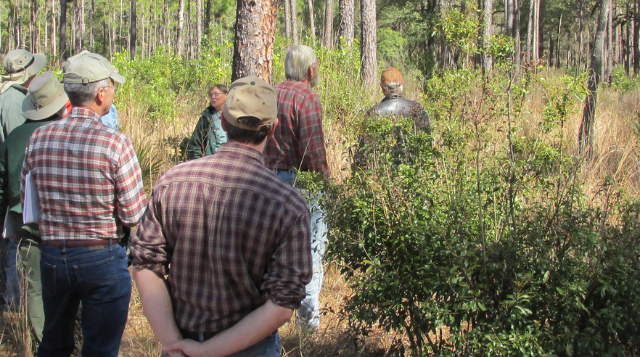
| Thanks to Stewards for Hosting Tours |
Many
thanks to the Forest Stewards that hosted tours on their properties this
year! Some of our certified Stewards hosted tours to provide others the
opportunity to witness and discuss the outcomes of the management practices
used to reach their multiple use forest management objectives. Participation
varied from 20+
down to 5 or 6 and representatives of the Florida Division of Forestry,
Florida Fish and Wildlife Conservation Commission and the University of
Florida Cooperative Extension Service were present at each tour.
Ideal weather prevailed for all the tours and a good time was had by all.
Our gracious hosts were:
|
| Timber Price Update |
The 1st quarter
2000 Timber-Mart South report for Florida listed average stumpage prices
as $33/cord for pine pulpwood, $85/cord for pine C-N-S, $111/cord for pine
sawtimber, and $123/cord for pine plylogs. Prices were down for the
first three products, respectively, and up slightly for plylogs compared
to 4th quarter 1999 prices. Hardwood pulpwood averaged $14/cord,
which was up slightly from the previous quarter. Stumpage prices
are highly variable and the actual price for a particular timber sale can
be affected by characteristics such as tract size, timber density, access,
proximity to operating mills, and weather. A more complete summary
of 1st quarter stumpage prices is available at your County Extension Office.
To determine current prices in your area, your best source of information
will be forestry consultants and timber companies that purchase timber
in your area. |
| SFRC and Forest Stewardship Program Workshop Schedule |
| SFRC Continuing Education Schedule
September 28: Forest Tree and Plant Identification, western Panhandle October 17-18: Biotechnology and Genetic Engineering for Foresters, Austin Cary Memorial Forest, Gainesville. November 14-15: Improving Public Relations (Getting the Message to the Public), Austin Cary Memorial Forest, Gainesville. January 2001: Environmental Impacts of Forestry Practices, Austin Cary Memorial Forest, Gainesville. Fall 2000: Regulatory Environment in Florida's Forests, Austin Cary
Memorial Forest, Gainesville.
Forest Stewardship Workshop August 1, 3: TimberMarket / Investment Opportunities, Bay & Lafayette
Counties.
|