THE AUSTIN
CARY MEMORIAL FOREST

Professional
schools are required to provide practical training and experimental
facilities to supplement students classroom and laboratory teaching
experience. The School of Forestry needed a forest to put into practice
the theories and principles of its academic subjects such as protection,
silviculture, mensuration, management, economics and others. This
section describes how the Austin Cary Memorial Forest came into
existence.
In 1936, there was an
abundance of forest land within Alachua County for sale at low prices,
some of it was tax delinquent. Even so, these lands were beyond
the financial resources of the struggling Forestry Department and
of the University as well. The Florida Board of Forestry, a friend
of the Forestry Department, had excess funds in its 1934-36 biennial
budget. Early in 1936, the Board authorized the purchase of 1,519
acres of forest land located along the Seaboard Railroad 12 miles
north of Gainesville, between Fairbanks and Waldo. The Board conveyed
title to this land and jurisdiction over it to the University of
Florida and its Department of Forestry.
The land was typical
of longleaf-slash pine timber lands of the naval stores belt; its
former owners were largely naval stores operators. One of them,
Louis E. Mize, of Fairbanks, is notable for selling the 40-acre
block containing a lake, now appropriately named Lake Mize, for
a nominal sum -- a very generous arrangement. An adjacent 524 acres
were purchased in 1938 with state funds; the total 2,043 acres thus
met the 2,000-acre minimum set by the Society of American Foresters
to entitle the School of Forestry to be ranked as a "Grade
A" forest school. Purchased for less than $12,000, University
President John J. Tigert and the State Board of Forestry recognized
the appropriateness of naming it "The Austin Cary Memorial
Forest," to honor Dr. Cary.
The first order of business
was to fence the area and institute fire protection under the supervision
of a full-time superintendent. The land had been logged-over from
about 1900 to 1906. Later, the second-growth and cull trees were
turpentined for about 16 years. Cattle grazing was common in the
area after logging, and repeated burning kept the forest floor open
for grazing and turpentining. After 1938, there was an insufficient
number of trees more than 9 inches dbh to continue turpentining
until a growing stock could be built-up.
In 1939, the Work Progress
Administration (WPA) built roads, buildings, and water draining
ditches. And 100,000 board feet of pine and 80,000 cypress shingles
were logged from the forest and processed at the School's sawmill.
The primary aim of timber
management has been to strive for adequate reproduction through
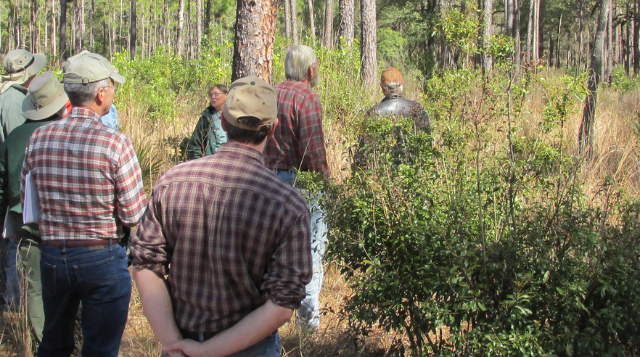
protection and to increase stocking of the forest. Students have
used the area as an outdoor classroom to acquire field knowledge
and experience. Other uses have been for experimental and demonstrational
purposes. Toward these ends, periodic timber harvests have been
conducted since about 1950, with early cuttings concentrating on
thinning to remove old naval stores trees and for stand improvement.
The Austin Memorial Cary
Forest is a valuable natural laboratory of the University of Florida
for forest resource education, demonstration, and research. In 1987
a rustic 3,200-sq.ft. teaching-conference center was completed on
the grounds where class lectures and conferences are today commonplace.
The unusually broad range of forest types, existing and possible,
affords a rare opportunity for educating forestry students, informing
laymen, and stimulating research projects on the management of forests
common to Florida and to the lower Coastal Plain region. Realization
of the full potential of the Austin Cary Memorial Forest requires
a substantial commitment in the future to address the wide diversity
of ecosystem and management practices.